Are you working as a babysitter or planning to start? This guide covers the updated 2026 rates in Mexico, the average hourly pay, and practical examples to help you calculate how much to charge based on your experience, location, and work schedule.
Just started babysitting and not sure what to charge? Or maybe you’ve been at it for a while and want to know if your rate is fair? In Mexico, the average hourly rate for a babysitter in 2026 is around $170 MXN (gross), based on Sitly’s data.
But this is only a general benchmark that covers very different situations. In practice, prices can vary widely: from $120 MXN per hour to more than $220 MXN, depending on the babysitter’s experience, the services requested, your location, and other factors.
In this guide, you’ll find everything you need to understand how much to charge as a babysitter, how to calculate your babysitting rate, and when it’s reasonable to ask for a higher wage.
How Much Does a Babysitter Earn per Hour?
As mentioned earlier, the average hourly rate for a babysitter in Mexico is $$170 MXN, according to Sitly data. Of course, this is only an average, and your rate may be higher or lower depending on your situation. The starting point for calculating your rate is the minimum wage set by law, which serves as a reference so you don’t charge below what’s fair.
From there, personal and practical factors come into play: the city where you work, your skills, the age and number of children you care for, the schedule (daytime or nighttime), and the type of work arrangement you have with the family. Let’s look at what the minimum wage in Mexico.
Minimum Wage for Babysitters in Mexico
In Mexico, a babysitter who works formally, meaning with an employment contract, is entitled to receive at least the current legal minimum wage for domestic workers. As of January 2026, the daily minimum wage for domestic workers was set at $315.04 MXN per day across most of the country. In the Northern Border Free Zone, which includes municipalities bordering the United States, the minimum is higher: $440.87 MXN per day.
These figures represent the legal minimum that cannot be reduced if you’re working formally. Mexican law also requires that domestic employment contracts guarantee vacation days, public holidays, a Christmas bonus (aguinaldo), a vacation premium, and enrollment in IMSS (the Mexican Social Security Institute).
While the law doesn’t set an official hourly rate, the government uses a standard eight-hour workday as a reference, which works out to roughly $39 to $55 MXN per hour, depending on the region. Actual hourly rates tend to be much higher than this. That’s because your pay depends not just on time worked, but also on your experience, the trust you’ve built, the number of children in your care, and any additional tasks you take on, such as preparing meals, helping with homework, or working nights.
Babysitter Rate: A Practical Example
Let’s imagine Ana, a 19-year-old with plenty of prior experience who has just started a degree in Early Childhood Education. She also holds a pediatric first-aid certification.
Once a week, she works for a family with three children aged 8, 5, and 3. She arrives at 4:00 p.m., picks up the youngest from kindergarten, then the two older kids from school. At home, they have a snack and play; if the weather’s good, they head to the park. Afterward, she makes dinner and makes sure the kids eat before the parents get home around 7:30 p.m.
What’s a Fair Rate for Ana? Breakdown of her rate:
We can work out a fair rate like this (estimated values for Mexico City in 2025):
- $120/hour = base rate, guided by minimum wage and proportional benefits
- +$20/hour = supplement for caring for three children instead of one
- +$10/hour = recognition for experience and pediatric first-aid certification
Total: $150/hour
For a 3.5-hour shift, that works out to:
$150 × 3.5 = $525 MXN
Hourly Babysitter Rates in Mexico’s Major Cities
Legal minimum wages serve as a reference point, but a babysitter’s actual pay is always agreed on directly between the family and the worker, and depends on many factors. One of the most important is the city you work in. Hourly rates can vary quite a bit from one place to another.
For example, a babysitter in Tijuana or Cancún tends to earn more than one in Puebla or Mexico City, though it all depends on the type of work, the hours, and your experience.
If you look after several young children, or have specialized training in first aid or early childhood education, you can earn more even in cities where the general average is lower. Check the map below to see how much babysitters earn per hour in Mexico’s major cities. These figures will give you a realistic idea of what to charge based on where you work.
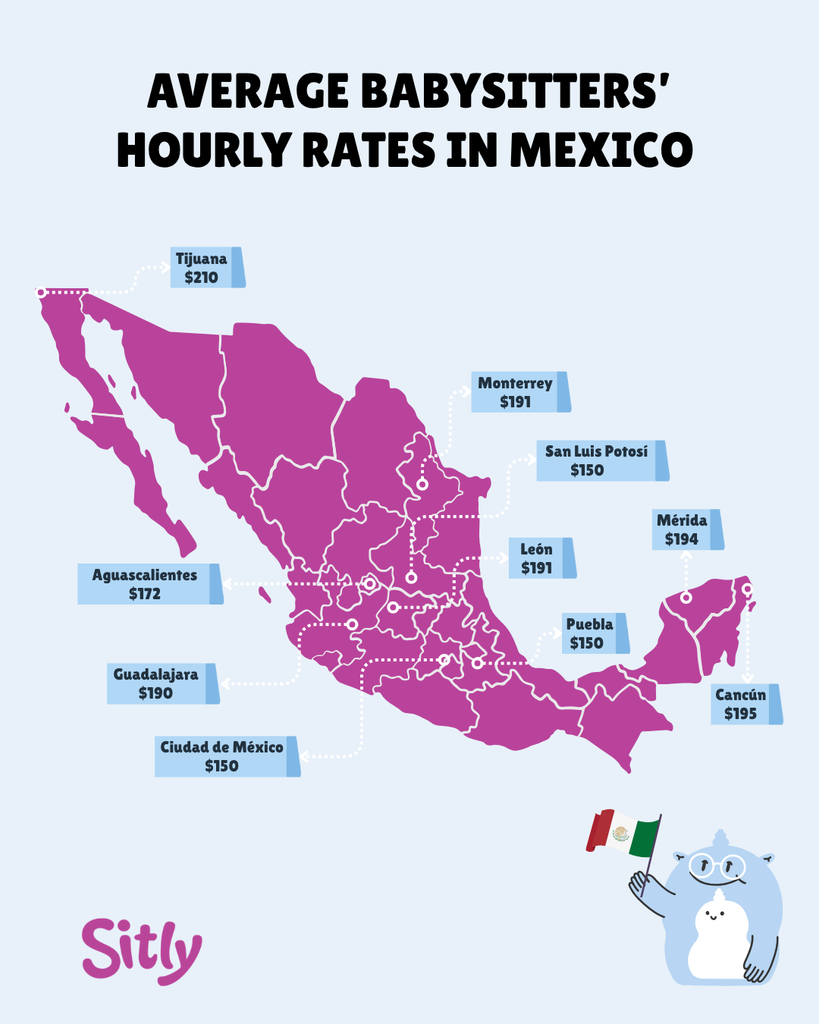
Average Hourly Babysitter Rates in Mexico (2026)
| City | Hourly Rate |
|---|---|
| Tijuana | $210 |
| Monterrey | $191 |
| León | $191 |
| Mérida | $194 |
| Cancún | $195 |
| San Luis Potosí | $150 |
| Puebla | $150 |
| Mexico City | $150 |
| Guadalajara | $190 |
| Aguascalientes | $172 |
Calculating Babysitter Pay
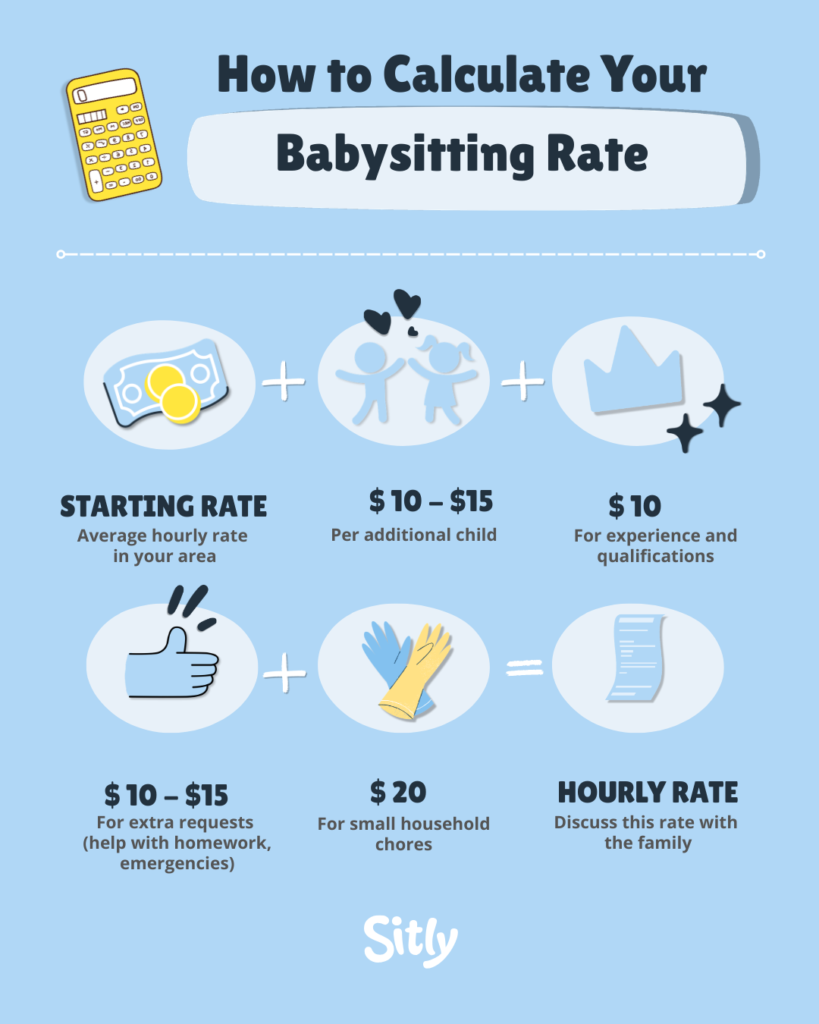
Beyond where you work, there are many other factors that can increase how much you earn as a babysitter: your experience, qualifications, the number of children you look after, and any extra tasks the family asks you to do. All of these influence your final pay and your hourly babysitting rate.
The infographic below helps you calculate a realistic hourly rate based on the work you do for the family. You can also try the Sitly calculator to instantly see babysitter rates in your area. Enter your city, the babysitter’s tasks, and the number of children, and get an immediate average rate.
Infographic: How to Calculate Babysitter Pay
How Much Does an Experienced or Qualified Babysitter Earn
If you’ve been working with children for years or have specific training (such as early childhood education, childcare assistant certifications, or first aid), you can charge more than the basic rates. Families are generally willing to pay higher wages when they see professionalism, confidence, and strong childcare skills.
How Much Does a Babysitter Earn per Hour for Two Children
When you take care of two or more children, your hourly rate can increase by 10–20% compared to your base rate, depending on the level of effort required. Caring for two young siblings, for example, requires more attention and energy than looking after one older child. And if the children have very different ages, managing their needs and finding suitable activities for both can be even more challenging.
Hourly Pay for Babysitters Who Do Light Household Tasks
Tidying up the playroom, preparing a child’s lunch, washing the dishes used by the children, or folding their clothes are considered part of your babysitting duties. However, if the family asks you to help with additional household tasks (such as folding the family’s laundry, dusting, or vacuuming), these are extra responsibilities that should be paid separately.
An increase of between $20 and $40 pesos per hour is reasonable when you take on these additional responsibilities.
Babysitter Rates When Using Your Own Car
Many babysitters pick up children from school, drive them to swimming lessons or dance class, and take them back home. If you use your own car for these trips, you can agree on a weekly or monthly reimbursement with the family to cover gas and travel costs.
How Much Does a Babysitter Earn in the Evening or Overnight
Night babysitting usually pays a bit more, since it involves less convenient hours or may even require staying overnight. In general, you can charge between 10% and 20% more than your daytime rate. For example, if you normally charge $170 MXN per hour, you can ask for between $185 and $200 MXN per hour when working at night or staying overnight.
That said, it also depends on the type of job:
- If the kids have already had dinner and go to bed shortly after, you can accept a slightly lower rate.
- But if you’re looking after babies or young children who wake up frequently, it’s fair to ask for a higher rate.
Tip: always talk to the parents about your safety getting home at night. Will they take you? Will they cover a taxi or a rideshare? Your safety should be the priority, and it’s important that it’s a responsibility shared between you and the family.
Babysitter Pay: Hourly Rate or Flat Fee?
Is it better to get paid by the hour or with a flat fee? It depends on the type of work you do for each family. For occasional jobs or when schedules change frequently, it’s better to agree on an hourly babysitting rate — you get paid only for the hours you actually work.
If instead you work regularly for one family, a fixed monthly fee can be convenient. In that case, it’s important to clearly define what is included in that monthly amount. For example:
- If the family doesn’t need you one day, do you still get paid?
- If something unexpected happens and they ask you to stay two extra hours, will those hours be paid separately?
- And what happens if you normally work on Tuesdays but there are five Tuesdays in a month?
Tip: Clarify these details in advance to avoid misunderstandings and maintain a calm, professional relationship with the family.
Last-Minute Babysitter Rate for Emergencies
What if the family calls you at the last minute because of an emergency? Maybe early in the morning because their child woke up with a fever. In most cases, you can ask for a higher rate (10–20% more) for last-minute requests.
It’s best to agree ahead of time on an “emergency rate” that applies whenever you’re asked to step in unexpectedly. This keeps everything clear and ensures your flexibility is fairly compensated.
Example: Marta, Emergency Backup Babysitter
Marta has an arrangement with a family to act as a backup babysitter for emergency situations. One morning, Sergio’s mom calls her at 7:00 a.m. because the boy has a fever and can’t go to daycare, but she has an important meeting to attend. Marta arrives at 8:00 a.m. and stays until 1:00 p.m., when the grandmother arrives.
How much does Marta charge?
$150/hour = standard base rate
+20% for the emergency = +$30/hour
Total: $180/hour
For a 5-hour shift:
$180 × 5 = $900 MXN
Many families round this up to $920 or $950 MXN to acknowledge the babysitter’s immediate availability. This way, Marta feels valued, and the parents have peace of mind knowing they can count on her in emergencies.
How Much Does a Babysitter Earn per Month?
A babysitter’s monthly income in Mexico can vary quite a bit depending on the hours worked and your level of experience. A part-time babysitter, working around 20 hours a week, can earn between $8,000 and $10,000 MXN per month.
If you work full-time and have training or experience with babies or children with special needs, your income can exceed $14,000 MXN per month. Some professional babysitters with greater responsibilities, or who live with the family (live-in babysitters), can earn even more, though these are typically formal jobs with a contract, benefits, and IMSS enrollment.
How Much Does a Babysitter Earn per Day?
If you only work as a babysitter on certain days, for example during school holidays or when the parents are away for work, you can agree on a daily rate instead of an hourly one.
The math is simple: multiply your hourly rate by the actual hours you work. An 8-hour day usually pays between $1,200 and $1,600 pesos, though the amount can go up if you’re looking after babies, preparing meals, or staying until nighttime.
Tip: agree with the family from the start on your schedule, the tasks you’ll be doing, and how overtime will be paid if they ask you to stay longer than agreed.
How to Set Your Babysitting Rate
To determine your hourly rate, you need to consider several factors:
- your qualifications and experience
- the number and ages of the children
- the average rate in your area
- the time of day you work (daytime or evening)
- the responsibilities the family expects you to take on
Once you’ve identified the rate that feels right for you, the next step is to discuss it openly with the family. It might feel a little awkward at first, but being clear about pay from the beginning is the best way to avoid misunderstandings and start the working relationship on the right foot.
A good approach is to come prepared: research the rates in your area and explain calmly during the conversation why your rate makes sense — for example based on the children’s ages, the schedule, or any extra tasks. You can also ask the family what amount they had in mind. This makes the discussion more open and transparent, making it easier to reach a fair agreement that works for both sides. Need more tips? Read are blog on how to become a great babysitter.
Table of contents


FAQ

While the law doesn’t set an official hourly rate, it uses an 8-hour workday as a reference. This works out to roughly $38 to $52 MXN per hour, depending on the region.
However, actual rates in the market tend to be higher, especially for hourly care, nights, weekends, or additional tasks.
.
Depending on the type of employment:
- With a formal contract: at least the legal minimum ($303.70 / $419.88 MXN per day), plus mandatory benefits.
Mexican law requires that domestic workers receive:
- Enrollment in IMSS
- A Christmas bonus (aguinaldo)
- Vacation days and a vacation premium
- Payment for public holidays
- A clear contract outlining hours and responsibilities
These benefits are mandatory and apply even if she works only a few hours a week.


Flexible babysitting jobs, just around the corner
Love spending time with kids? Become a Sitly Sitter! We connect you with families looking for a reliable sitter. Set your own schedule, choose your rates, and meet families nearby. Get started today!

Related Articles

Calculate Your Babysitter’s Rate with the Sitly Calculator
Find out how much to pay a babysitter in your area. Sitly’s Babysitter Rate Calculator shows average rates across Mexico to helps you estimate a fair hourly wage based on your city, number of children, and any extra duties.

15 Easy Part-Time Jobs as a Student — from Babysitting to Tutoring and Private Lessons
In this guide, we’ve rounded up 15 of the best and most flexible side jobs. Many of them can be done from home, like filling out online surveys, babysitting, or tutoring, while others let you get outside, be creative, or meet new people.

How to Become a Great Babysitter
If you want to become a babysitter and find regular work, the key is to build experience, gain parents’ trust, and show that you take the role seriously. Even if you’re young, you can start by helping family members, offering to work as a “mother’s helper,” taking a First Aid and CPR course, and creating a professional babysitter profile on a platform like Sitly. By setting a fair hourly rate based on your age, experience, and responsibilities, and by going the extra mile during each job, you’ll increase your chances of getting more babysitting work and keeping parents happy.